Here we verify the conjecture for small numbers.
§1. On 7 June 1742, Christian Goldbach wrote a letter from Moscow to Leonhard Euler in Berlin making "eine conjecture hazardiren" that every even number greater than \INWEBMATH(2\INWEBMATH) can be written as a sum of two primes.1 Euler did not know if this was true, and nor does anyone else.
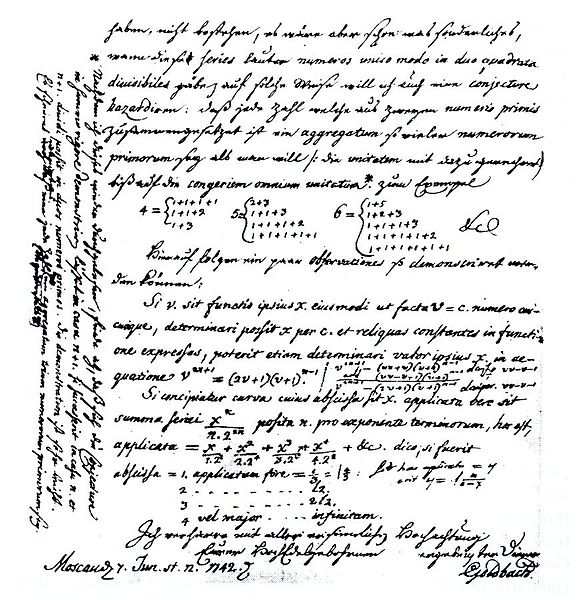
Goldbach, a professor at St Petersburg and tutor to Tsar Peter II, wrote in several languages in an elegant cursive script, and was much valued as a letter-writer, though his reputation stands less high today.2 All the same, the general belief now is that primes are just plentiful enough, and just evenly-enough spread, for Goldbach to be right. It is known that:
- every even number is a sum of at most six primes (Ramaré, 1995), and
- every odd number is a sum of at most five (Tao, 2012).
1 "Greater than 2" is our later proviso: Goldbach needed no such exception because he considered 1 a prime number, as was normal then, and was sometimes said as late as the early twentieth century. ↩
2 Goldbach, almost exactly a contemporary of Voltaire, was a good citizen of the great age of Enlightenment letter-writing. He and Euler exchanged scholarly letters for over thirty years, not something Euler would have kept up with a duffer. Goldbach was also not, as is sometimes said, a lawyer. An edited transcription of the letter is online here. ↩
§2. Computer verification has been made up to around \INWEBMATH(10^{18}\INWEBMATH), but by rather better methods than the one we use here. We will only go up to:
define RANGE 100
#include <stdio.h>

int main(int argc, char *argv[]) {
    for (int i=4; i<RANGE; i=i+2) /* stepping in twos to stay even */
        Solve Goldbach's conjecture for i2.1;
}
	$ goldbach/Tangled/goldbach
	4 = 2+2
	6 = 3+3
	8 = 3+5
	10 = 3+7 = 5+5
	12 = 5+7
	14 = 3+11 = 7+7
	...
We'll print each different pair of primes adding up to \INWEBMATH(i\INWEBMATH). We only check in the range \INWEBMATH(2 \leq j \leq i/2\INWEBMATH) to avoid counting pairs twice over (thus \INWEBMATH(8 = 3+5 = 5+3\INWEBMATH), but that's hardly two different ways).
Solve Goldbach's conjecture for i2.1 =
    printf("%d", i);
    for (int j=2; j<=i/2; j++)
        if ((isprime(j)) && (isprime(i-j)))
            printf(" = %d+%d", j, i-j);
    printf("\n");
- This code is used in §2.